Exotic Gems, Volume 1
HOw to identify and Buy Tanzanite, Ammolite, Rhodochrosite, Zultanite, Sunstone, Moonstone & other Feldspars
Discover Exotic Gems
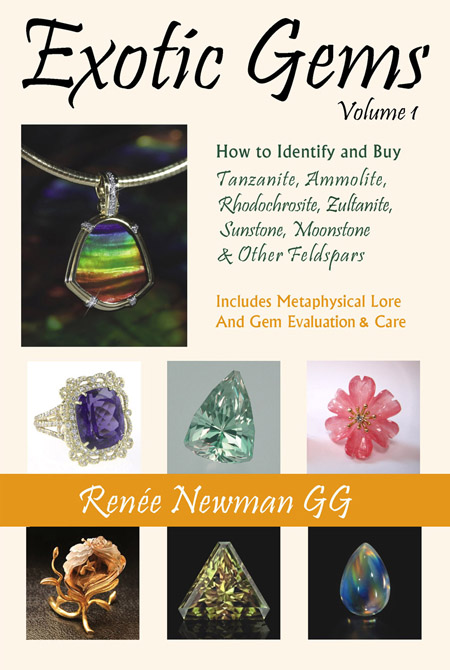 This
is the first in a series of books that will explore the history, lore,
evaluation, geographic sources, and identifying properties of lesser-known
gems. Exotic Gems Volume 1 has 288 color photos of mounted and
loose tanzanite, ammolite, zultanite, rhodochrosite, sunstone, moonstone,
labradorite, spectrolite, andesine, amazonite, bytownite, orthoclase and
oligoclase. Some of the pictures are close-up shots that show how to make
visual judgments about clarity, transparency, color, cut quality and
brilliance. A few pictures show how the gems are cut and many others show
creative jewelry designs with these stones. Exotic Gems also
provides tips on caring for the gems, selecting an appraiser and on
detecting imitations and gem treatments. The healing and metaphysical
properties of the gems are also addressed. Written for both consumers and
professionals, it’s easy to read, well-organized, and packed with
fascinating information and photos. If you’re interested in colored
gemstones, you’ll find Exotic Gems to be a valuable resource that
will help you discover and buy unusual gem varieties you may never have
seen before.
This
is the first in a series of books that will explore the history, lore,
evaluation, geographic sources, and identifying properties of lesser-known
gems. Exotic Gems Volume 1 has 288 color photos of mounted and
loose tanzanite, ammolite, zultanite, rhodochrosite, sunstone, moonstone,
labradorite, spectrolite, andesine, amazonite, bytownite, orthoclase and
oligoclase. Some of the pictures are close-up shots that show how to make
visual judgments about clarity, transparency, color, cut quality and
brilliance. A few pictures show how the gems are cut and many others show
creative jewelry designs with these stones. Exotic Gems also
provides tips on caring for the gems, selecting an appraiser and on
detecting imitations and gem treatments. The healing and metaphysical
properties of the gems are also addressed. Written for both consumers and
professionals, it’s easy to read, well-organized, and packed with
fascinating information and photos. If you’re interested in colored
gemstones, you’ll find Exotic Gems to be a valuable resource that
will help you discover and buy unusual gem varieties you may never have
seen before.
Exotic Gems, Volume 1: How to Identify & Buy
Tanzanite, Ammolite, Rhodochrosite, Zultanite
Sunstone, Moonstone & Other Feldspars
by Renée Newman ISBN 978-0929975-42-9
Click to Buy from Lithographie.org
Click to Buy from Amazon.co.uk
Paperback / 6" x 9" / 154 pages, International Jewelry Publications / $19.95
Reviews
Renee
Newman knocks it out of the park again!!!! In her latest book Exotic
Gems: How to Identify and Buy Tanzanite, Ammolite, Rhodochrosite,
Zultanite, Sunstone, Moonstone & Other Feldspars (Newman Exotic Gem
Series) Ms. Newman opens the world of the exotic to her loyal
fans.
The great
thing about any Renee Newman guide is that she writes for everyone - the
professional jeweler, gemologist and hobbyist will all be able to glean
important information and inspiration from her books.
In the
first volume of her Exotic Gems series Newman looks specifically at
Tanzanite, Ammolite, Rhodochrosite, Zultanite and several of the Feldspar
family of gems (Moonstone, Labradorite, Spectrolite, Sunstone and more).
In words
that everyone can understand she walks you through the chemical, physical
and optical qualities and then she takes you to the mines, shows you what
it takes to cut some of these exotics and then finishes up with some of
the most gorgeous photos of faceted gems, carved gems and gems in
jewelry...and she even talks about the Metaphysical Lore of the gem.
The
popularity of the television shopping networks has opened up a new era in
gems in jewelry - there was a day when gem rhodochrosite was considered
too soft for jewelry and it was only found in mineral collections - those
days are gone and Renee Newman's book give us the information we need to
make decisions about using these materials in jewelry and for those
looking to purchase them.
This book
is worth buying just for the "eye candy" value - delightful to
see such a great range from bridge to fine jewelry - cutters to carvers.
Thanks Renee - I am looking forward to volume two!
Robyn Hawk, “Reading it All”
. . . This book [Pearl Buying Guide] is heavily weighted with gemstone evaluation as in Newman’s other guides. It is therefore of value to the student of gemmology and layperson alike. There is information about the history lore, geographic sources and care of the gems. . . An easy read, Renée Newman’s new book seems to have something for everyone whether it be informative gemmological facts, the mystic side of gems, an aid to buying or an appreciation of excellent photographs, both of gems and of jewellery. It can be read in its entirety or consulted as a reference for exotic gems.
Australian Gemmologist
This nifty little book fills a long-neglected area of consumer gem knowledge – that of the lesser-known, but important jewelry and collector’s gemstones.
After a brief introduction to the subject in chapter one, the next two chapters explore price factors and treatments in detail. Excellent line drawings help to explain the basic terminology of the parts of a gemstone cut, gemstone shapes and gemstone cutting styles. Ms Newman has a gift for bringing clarity to the obscure, and here, her judicious use of photos makes judgment of cut qualities, such as brilliance and windowing, easy for the layman to undertake with a degree of confidence.
Part of the fun of this book is derived from the many phenomenal gems that are included and their outstanding photos, taken or sourced by the author. One particular treat is a four-page spread on "How a Master Cutter Cuts a Zultanite". Zultanite, or color-change diaspore, is a gem of recent interest and I was happy to pick up more information on it.
Rarely seeing many good photos of ammolite and rhodochrosite, I was wowed by the variety of stones and the different jewelry designs. The wealth of photos continued throughout the chapters on sunstone and moonstone, including the newer Tanzanian sunstone that has a spangled or confetti effect.
Of special interest were charts on the placement of feldspars according to their chemical makeup, including an end-member diagram with gems photographically illustrated at the appropriate points on the scale between potassium, sodium and calcium.
The last chapter on choosing an appraiser gives sound advice and includes information on her website where the link to NAJA is listed.
This book would be an excellent book to recommend to clients and a very handy reference for your library.
Blaire Beavers, NAJA Jewelry Appraiser
The
rarest gems can be the most beautiful. “Exotic Gems” is a guide to the
many rare gems around the world that have their own attraction. With tips
on identifying these rare gems, where they come from and how did they
form, the mythology behind them, and how to buy them without getting
burned, Renee Newman gives readers a complete and comprehensive guide to
these gems, making “Exotic Gems” a choice and very highly recommended
pick.
Last
spring we looked at Renée Newman’s third edition of her Ruby,
Sapphire & Emerald Guide. The prolific author has followed up a
year later with Volume 1 of a series entitled Exotic Gems, which
focuses on a group of lesser known gemstones.
Author and gemologist Newman credits television shopping networks
with introducing the public to gemstones such as rhodochrosite and
diaspore—material that wasn’t often used in jewelry—as well as
creating a market for information, which she provides.
Newman begins Chapter 1 of the book by explaining that the term
“exotic” can mean unusual, if not always foreign, so that
ammolite from northern Alberta may still be considered exotic to
Canadians, even if it is domestic. Chapters 2 and 3 provide an overview of
the factors that affect price: the Cs (color, clarity, cutting style and
shape, cut quality, carat weight), transparency, treatment, brilliance,
brand, and phenomena. Chapter 4 follows with definitions of gemstone
identification terms.
Then on to the stones themselves, beginning with tanzanite in
Chapter 5. Having issued a book in 1996 on emerald and tanzanite—now out
of print, Newman gives a new life in these pages to what is probably the
most famous of the Volume 1 group. (Emerald was revived by Newman, in
turn, in last spring’s Ruby, Sapphire & Emerald Guide.) History
and geographic sources are explored; also nomenclature (tanzanite is a
variety of zoisite). Treatment is highlighted, since tanzanite is almost
always heated; other treatments also are discussed. Pleochroism and
lighting both are nicely illustrated. (Did we mention that the book
features nearly 300 color photographs?)
Metaphysical lore is covered in the book for nearly every type of
gemstone presented—even tanzanite, which is a relatively recent
discovery. Identifying characteristics are summarized in a convenient
table, accompanied by several photos. Price factors—including two
examples of recutting—and care of tanzanite round out the chapter, and
provide a pattern for those that follow.
Chapter 6, on zultanite (aka gem-quality, color-change diaspore),
while omitting any mention of lore, does feature a four-page pictorial on
cutting the variety by master cutter Stephen Kotlowski. Lots of lore is
included for ammolite in Chapter 7, as one look at the material in matrix
would suggest—the iridescent gem having been formed within the
fossilized mollusk ammonite. Rhodochrosite, while surely being familiar to
our readers, is beautifully illustrated in Chapter 8, with 18 photos
showing this gemstones many manifestations.
Chapters 9 through 12 cover the feldspar group—sunstone,
moonstone, and the rest well-illustrated chapters nicely guide the reader
through territory that sometimes can be a little daunting. The inclusion
of H. A. Hanni's feldspar-triangle chart should be useful in that regard,
with photos of the varieties themselves illustrating the edges.
Newman closes the book with a chapter, 13, reminding us that even
with the information provided in her pages, a qualified appraiser could be
a gem buyer’s best friend, especially in the case of a purchase of any
significance. A three-page bibliography also is included.
You’ll be surprised how much useful information can be poured
into 154 pages—and don’t miss the lovely inside covers.
David Hughes, "Pala's Gem News"
Newman Gem & Jewelry Series and Osteoporosis Book Links
Diamond Ring Buying Guide, Details & Reviews
Diamonds: Their History, Sources, Qualities and Benefits
Gemstone Buying Guide, Details & Reviews
Gem & Jewelry Pocket Guide, Details & Reviews
Pearl Buying Guide, Details & Reviews
Ruby, Sapphire & Emerald Buying Guide, Details & Reviews
Osteoporosis Prevention, Details
Exotic Gems, Volume 1, Details and Reviews
Exotic Gems, Volume 2, Details & Reviews
Exotic Gems, Volume 3, Details
Exotic Gems, Volume 4, Details & Reviews
Rare Gemstones, Details & Reviews
Gold, Platinum, Palladium, Silver & Other Jewelry Metals